Friday, 3 November 2017

Electricity workshop

We did an electricity workshop today to explore the fantastic electric circuit equipment in the school.  I put together 7 problems using bulbs, batteries, switches and buzzers to allow the participants to work out how to put together some basic circuits for particular applications.
We did:
Series circuits,
Parallel circuits,
Motors,
Master switches,
Alarm circuits
and a Morse code transmitter.

Then we looked at some measuring activities using a houshold multimeter.
We investigated:
Conductivity of liquids,
How number of batteries affects the current,
and How number of bulbs affects the current.

We also had a very little look at electromagnets!

Here are some photos:


And here are links to the experiments that we did today:

Link to a pdf version of the problems: Electricity problems

Link to the pdf version of the individual handouts: Handouts for solving the problems

It was really fun and I hope that I gave you some ideas about how to use these great resources.  Thanks for coming.

Jenny

Measuring reflexes with sexto (by Elena)


Elena tried out the reflexes activity with her sexto class.  It is a really simple way to get the students thinking about how different parts of our bodies communicate and why these communications are not instantanious.  All you need is 30 cm rulers.
Usually this activity involves a lot of cheating (especially from competitive boys), but it is fun and it does not really matter.  Get the students to think about doing a "fair test" and sources of error (lots!).  The main focus of the activity is on data collection using a tally chart to measure frequency.  They you can get them to plot a bar chart - if they do it properly you will get a bell curve, but they probably won't which is ok.
 
All data collection and graph drawing us useful to prepare them for secondary school.

Link to instructions and worksheet: Reflexes Activity

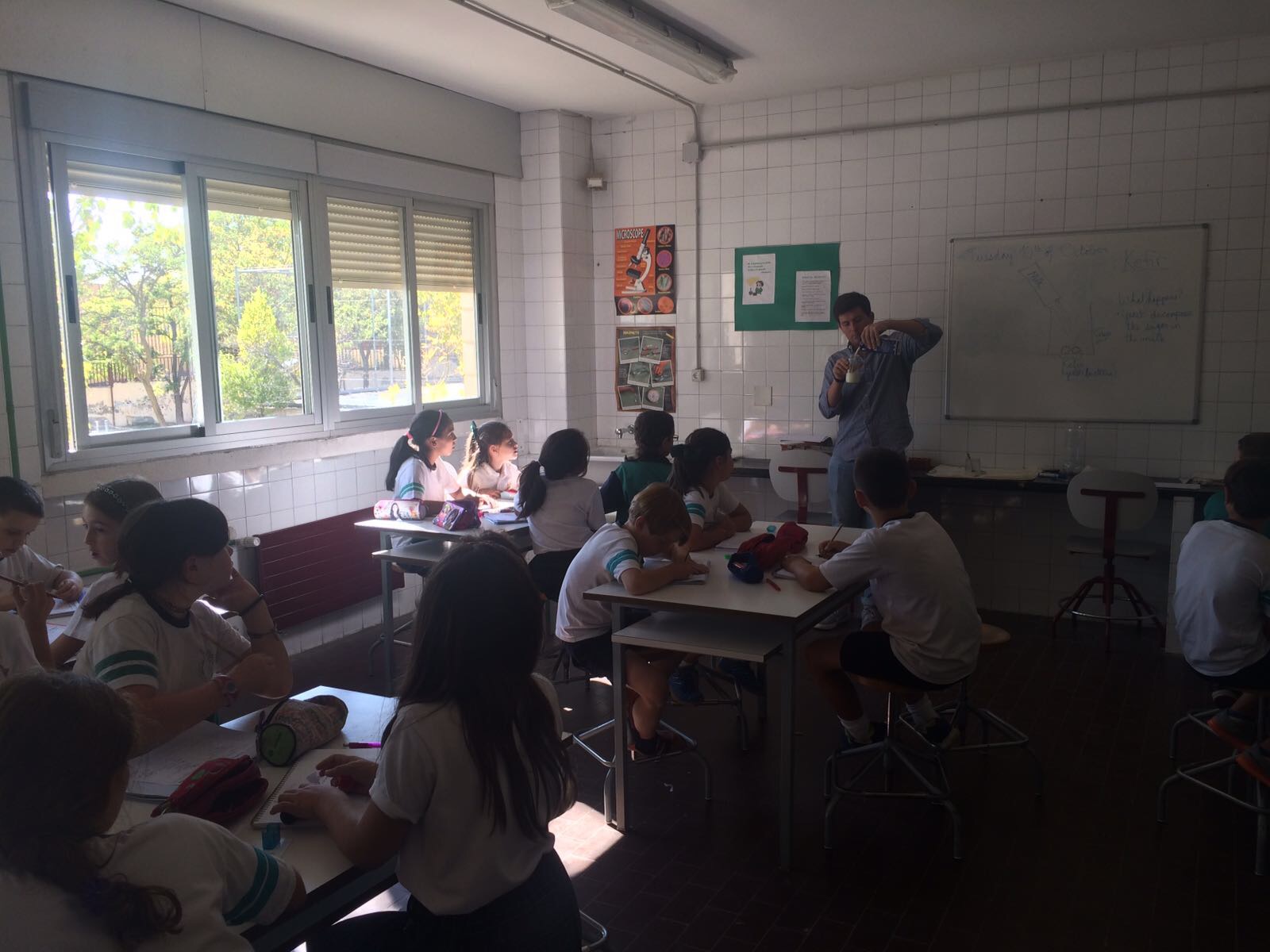
Making kefir yogurt

Teach kids about yeast and fermentation with food!!!!!!

Kefir is an easier dairy fermentation science experiment to do. It is a traditional fermented food made from milk, full of beneficial probiotic bacteria and yeast. It's similar to yogurt.

Try more dairy fermentation science at home with a yogurt recipe:


Yogurt is also fermented milk, but is made differently. And, there are different types of yogurt, such as greek yogurt.

Here is an article that explains this more thoroughly:
http://www.culturesforhealth.com/learn/yogurt/how-to-make-homemade-yogurt/

Friday, 20 October 2017

Camera Obscura - Working Model Eye (Sexto) By Elena


Elena's students build working models of eyes (camera obscura) in class using shoe boxes and tracing paper. 
Then they went out on a sunny day and tested them on the patio.  The construction is relatively simple but what you see inside the box - the world projected upside-down is weird and fascinating.  You can tie this in to the nervous system and the brain because the information that the eye collects is upside-down and the brain corrects it for us.  We don't see the world upside-down, our brain is too clever and adaptable for that.  Safety warning - Don't look at the sun!
Link to pdf:  Instructions and Information for Camera Obscura Activity

Sunday, 8 October 2017

KUBB: plastic-free, wooden game.

Stone Age, Bronze Age… Plastic Age?

The one material named by nearly all sources  was plastic. Plastic “has redefined our material culture and the trush we leave behind”
Kubb is a good outdoor game from Sweden.  Also known as Viking Chess.


And the most important,  Kubb set is crafted from eco-friendly material.

CLIMATE CHANGE is really not the issue.
BASIC EDUCATION and our ATTITUDE is !

Thanks to AMIGOS DEL KUBB.

Saturday, 23 September 2017

Mini Chemical Reactions - Primero hasta tercero de primaria

This is a very simple and controlled way for children to explore chemical reactions with relatively little mess.  I made jelly from the purple water from boiled red cabbage and I allowed it to gel in a plastic container (a thin layer).

To the thin layer of purple jelly, you can add drops of lemon juice, vinegar, sodium bicarbonate and ammonia (if supervised).  Acids make the jelly turn from purple to pink and alkalis make it turn blue, green and even yellow.  We used pipettes (or syringes) to add drops and the colour changes are reversible.


Adding sodium bicarbonate at acid on the jelly makes carbon dioxide bubbles and the colour changes were quite beautiful.  Plus my kids were fascinated by the texture of the jelly and by using the pipettes to transfer liquids.  You could photograph the mixtures and have a science-art project!


You need:
  • plastic containers
  • red cabbage
  • gelatine
  • lemon juice
  • vinegar
  • sodium bicarbonate dissolved in water
  • (diluted ammonia - small group supervised activity)
  • pipettes or syringes
  • containers for the lemon juice, vinegar and sodium bicarbonate 
 Good experimental chemistry with surprisingly little mess!

Friday, 15 September 2017

New School Year!

September is here and we´re all super busy.  Firstly, if you have material from last term, please send it to me to post.  Secondly, Nieves and I were talking about maybe doing another workshop at the end of October.  If you have ideas or requests for what to do, please tell us.


Septiembre ha llegado y estamos super ocupados.  Primera cosa, si tienes material/fotos del año pasado para subir al blog por favor mandármelas para que puede incluirlas.  Segunda cosa, Nieves y yo estamos pensando en tener otro taller al fin de octubre.  Si tienes ideas o sugerencias sobre temas por favor dinos.

Un saludo
Jenny